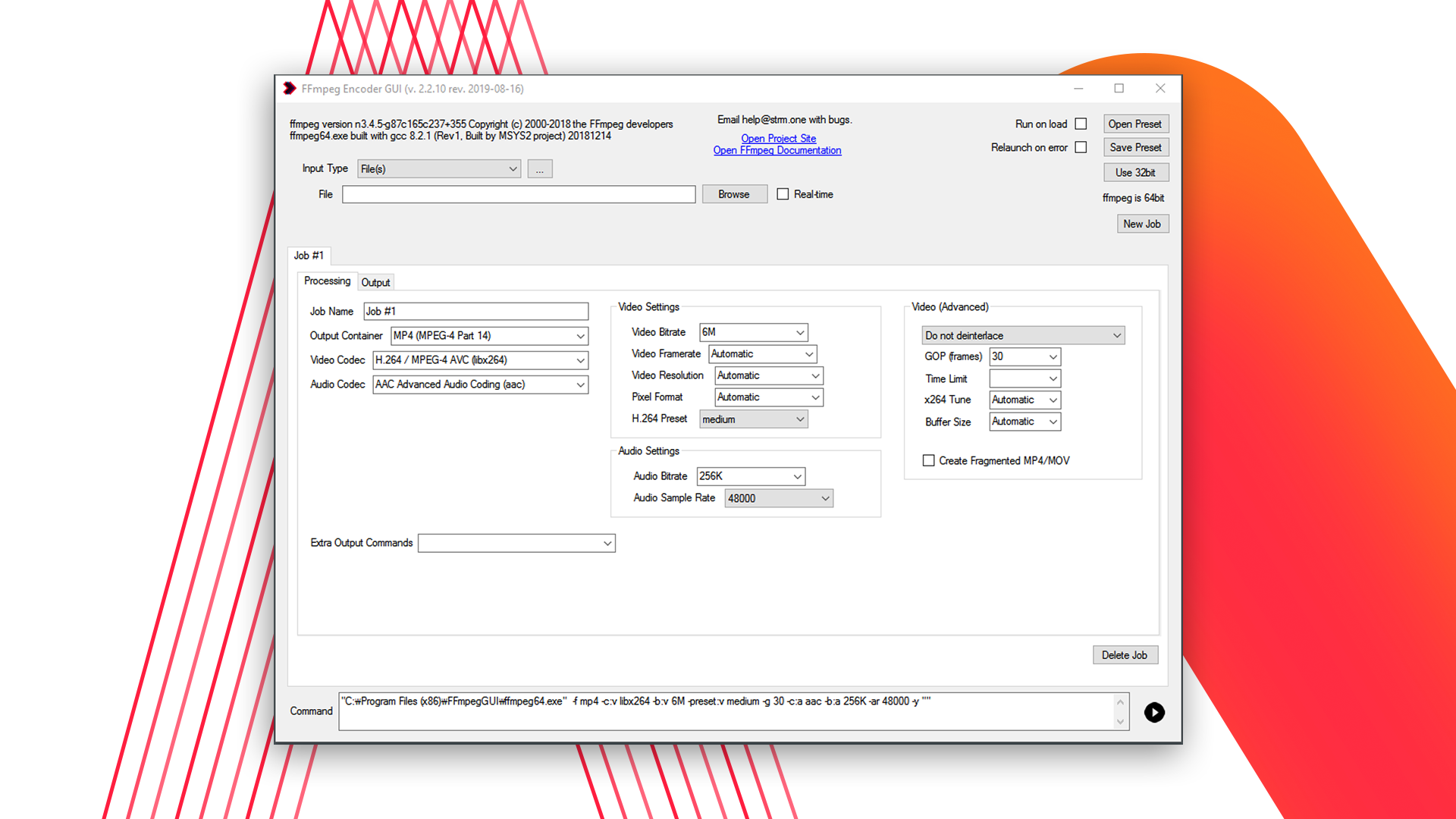
Added option to auto-relaunch if streaming/encoding pipeline stalls
Added real-time buffering checkbox to "URL" input options
Fragmented MP4 flag changed to "-movflags frag_keyframe+empty_moov" to conform to latest guidance
Added option to write FFmpeg output to weekly rotating logfile
Added menu option to save currently open preset without prompting for filename (i.e. File > Save)
Fixed minor cosmetic bug on main page
Fixed minor cosmetic bug on Encoding Status page
Fixed error with duplicate DirectShow devices
Fixed bug with non-ASCII DirectShow device names
Added textbox to provide custom input commands
Added input decoder read buffer option
Added NVENC presets list
Status display expanded with restart & kill commands
File output selection now includes filename prompt
Improved bitness checking allowing for smaller install footprint
Miscellaneous minor changes
Original release

FFmpegGUI currently supports File, DirectShow, Blackmagic Decklink, NewTek NDI or URL inputs.
Drag and drop your file(s) from your system to be processed quickly.
Prompting to rename any input file(s) with non-ASCII filenames to be compatible with command-line processor.
You can easily export your clip(s) to a file, NewTek NDI destination, RTMP server or any other custom output supported by FFmpeg.
The included FFmpeg is built with hardware encoding support for NVENC. GUI support is experimental at this time, feedback is welcome.
32-bit and 64-bit Windows binaries of FFmpeg included. Current binaries are based on version 3.4.5.
Save your encoding settings as file to be recalled later. Settings are formatted as an XML document.
GUI project is developed by ffmpeg fans and distributed for any usage. Non-free codecs in the included FFmpeg build may have further restrictions.
The Nexus Player used an Intel Atom (x86) processor, making it surprisingly compatible with older PCs. If you have an old laptop or desktop, you can turn it into an Android TV box using an x86 port of Android TV. Where to Find the "ISO"
: Flashing your device (unlocking the bootloader, installing custom recovery, or flashing firmware) carries inherent risks. It will void your warranty (if any remains) and, if done incorrectly, could permanently damage your device. The information provided here is for educational purposes, and you should proceed at your own risk.
The final official release, featuring a completely redesigned home screen centered on channels and content recommendations. Custom ROMs and Alternative Operating Systems
Watch this step-by-step guide to installing a real Android TV experience on a PC using Nexus Player image files: nexus player iso
In Developer Options, enable and OEM Unlocking . Open your PC command prompt and type: adb reboot bootloader
As the day outside thickened into evening, Mira fed herself on the city's small rituals. She learned the tram conductor's route in a way you learn a song's chorus; she memorized the arc of the gulls above Harbor 4. She discovered alleyways painted with murals that changed their graffiti when nobody watched. Each element had metadata — not dull tags but the city’s tone: when a bench had been stolen, when the florist's husband had left, when the siphon in the arcade had been fixed. The ISO did not only store object files; it stored the patience with which memory forgives inconsistency.
Once you have the prerequisites, here is the general process for flashing a factory image: The Nexus Player used an Intel Atom (x86)
The safest and most official source for these files is . Google maintains a page dedicated to "Factory Images for Nexus and Pixel Devices," which serves as the central repository for all official firmware.
A factory image is the full software package for the device. It includes: The low-level code that starts the device. Radio/Baseband: Hardware communication drivers.
Unzip the downloaded factory image and run the flash-all.sh (Linux/Mac) or flash-all.bat (Windows) script. Relock Bootloader: Run fastboot oem lock . 2. Running Nexus Player Android TV on PC (x86 ISO) It will void your warranty (if any remains)
The final official build released by Google for the Nexus Player was Android 8.0.0 Oreo (Build OPR6.170623.011, Mar 2018).
When users search for a Nexus Player ISO to fix a bootloop or refresh their device, the safest starting point is the official Google Factory Image repository. Google released images spanning from Android 5.0 (Lollipop) up to Android 8.0 (Oreo), which was the final official update for the device (codename: "fugu"). Key Official Firmware Versions:
Connect the Nexus Player to your computer via the Micro-USB cable.
While the Nexus Player lacks the 4K capabilities and processing speeds of modern hardware like the Chromecast with Google TV or the Nvidia Shield, it remains a fun, customizable gadget for tech hobbyists. Whether you choose to preserve its legacy using the final Android 8.0 Oreo factory image or push its limits with custom LineageOS builds, knowing how to navigate its firmware partitions ensures this classic streaming device stays out of the landfill.